

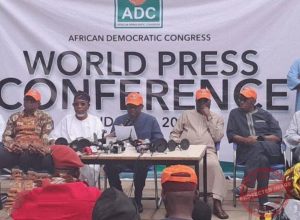
 The ADC crisis Nigeria has raised concerns and at the center of the dispute is Bala Gombe, a former National Deputy Chairman of ADC, who has declared himself the substantive National Chairman, despite an earlier agreement by party leaders to step aside following coalition arrangements and the emergence of a caretaker structure reportedly backed by figures like David Mark.
This development has not only split the party but has also intensified suspicions that the crisis may not be entirely organic.
The ADC crisis Nigeria has raised concerns and at the center of the dispute is Bala Gombe, a former National Deputy Chairman of ADC, who has declared himself the substantive National Chairman, despite an earlier agreement by party leaders to step aside following coalition arrangements and the emergence of a caretaker structure reportedly backed by figures like David Mark.
This development has not only split the party but has also intensified suspicions that the crisis may not be entirely organic.
 ADC Crisis Nigeria: A Familiar Political Pattern?
For many Nigerians, the unfolding events in ADC mirror past political disruptions across opposition parties.
Within the Peoples Democratic Party (PDP), internal divisions have persisted, with influential figures like Nyesom Wike, now serving under an APC-led federal government, continuing to wield significant influence. This overlap between ruling party power and opposition party dynamics has raised questions about the independence of party structures.
ADC Crisis Nigeria: A Familiar Political Pattern?
For many Nigerians, the unfolding events in ADC mirror past political disruptions across opposition parties.
Within the Peoples Democratic Party (PDP), internal divisions have persisted, with influential figures like Nyesom Wike, now serving under an APC-led federal government, continuing to wield significant influence. This overlap between ruling party power and opposition party dynamics has raised questions about the independence of party structures.
 Similarly, the Labour Party has faced prolonged leadership disputes, multiple court cases, and factional claims, leaving the party weakened at critical political moments.
To many observers, these recurring crises are not isolated coincidences but part of a broader pattern where opposition parties struggle to maintain unity amid legal battles, leadership tussles, and institutional interventions.
Similarly, the Labour Party has faced prolonged leadership disputes, multiple court cases, and factional claims, leaving the party weakened at critical political moments.
To many observers, these recurring crises are not isolated coincidences but part of a broader pattern where opposition parties struggle to maintain unity amid legal battles, leadership tussles, and institutional interventions.
 The Role of INEC and the Judiciary
The involvement of INEC and the courts has become central to the ADC crisis.
INEC’s power to recognize party leadership gives it enormous influence in determining which faction gains legitimacy. In highly contested situations, this recognition can effectively decide political outcomes, making neutrality and transparency absolutely critical.
The Role of INEC and the Judiciary
The involvement of INEC and the courts has become central to the ADC crisis.
INEC’s power to recognize party leadership gives it enormous influence in determining which faction gains legitimacy. In highly contested situations, this recognition can effectively decide political outcomes, making neutrality and transparency absolutely critical.
 The judiciary, on its part, has issued orders aimed at stabilizing the situation. However, the application of status quo ante bellum, a directive to revert to the state of affairs before the crisis, has created fresh ambiguity.
Rather than resolving the dispute, this has allowed:
1. The Bala Gombe faction to assert legitimacy based on prior structures
2. The David Mark-backed leadership to claim authority under the same interpretation
Observers of the ADC crisis Nigeria believe that this duality has deepened confusion and reinforced perceptions that judicial interventions sometimes prolong political crises instead of ending them.
The judiciary, on its part, has issued orders aimed at stabilizing the situation. However, the application of status quo ante bellum, a directive to revert to the state of affairs before the crisis, has created fresh ambiguity.
Rather than resolving the dispute, this has allowed:
1. The Bala Gombe faction to assert legitimacy based on prior structures
2. The David Mark-backed leadership to claim authority under the same interpretation
Observers of the ADC crisis Nigeria believe that this duality has deepened confusion and reinforced perceptions that judicial interventions sometimes prolong political crises instead of ending them.
 Historical Precedent: The Kogi Case
Nigeria’s political history offers examples that continue to shape public perception.
During the 2015 Kogi State governorship election, the death of Abubakar Audu before the final declaration led to a controversial substitution process. The All Progressives Congress replaced the original ticket with Yahaya Bello, sidelining the running mate James Faleke.
At the time, APC defended its action as an internal party matter, a position that was ultimately upheld within the legal and electoral framework.
Today, critics argue that the same principle is not being consistently respected when it comes to opposition parties managing their internal affairs.
Historical Precedent: The Kogi Case
Nigeria’s political history offers examples that continue to shape public perception.
During the 2015 Kogi State governorship election, the death of Abubakar Audu before the final declaration led to a controversial substitution process. The All Progressives Congress replaced the original ticket with Yahaya Bello, sidelining the running mate James Faleke.
At the time, APC defended its action as an internal party matter, a position that was ultimately upheld within the legal and electoral framework.
Today, critics argue that the same principle is not being consistently respected when it comes to opposition parties managing their internal affairs.
 Allegations, Perceptions, and Political Reality
The ADC, under voices aligned with David Mark, has reportedly accused APC and INEC of interference, even taking the matter to the international stage. In response, APC officials have countered that the crisis is the result of internal hijacking by certain elements within the party.
What is undeniable, however, is this:
1. There are clear and recurring patterns of leadership disputes across opposition parties
2. Institutional actions, whether by INEC or the courts, often become decisive in these disputes
3. Political actors with cross-party influence continue to blur traditional boundaries
While the courts are yet to make a final determination, these factors have collectively fueled widespread suspicion among Nigerians.
What the ADC Crisis Nigeria Means for 2027 Elections
With the 2027 general elections on the horizon, the stability of opposition parties like ADC is critical to the health of Nigeria’s democracy.
A fragmented opposition:
1. Weakens electoral competition
2. Reduces voter confidence
3. Concentrates political power in fewer hands
Whether the ADC crisis is purely internal or influenced by external forces, its impact is the same, it threatens the balance necessary for a vibrant democratic system.
Allegations, Perceptions, and Political Reality
The ADC, under voices aligned with David Mark, has reportedly accused APC and INEC of interference, even taking the matter to the international stage. In response, APC officials have countered that the crisis is the result of internal hijacking by certain elements within the party.
What is undeniable, however, is this:
1. There are clear and recurring patterns of leadership disputes across opposition parties
2. Institutional actions, whether by INEC or the courts, often become decisive in these disputes
3. Political actors with cross-party influence continue to blur traditional boundaries
While the courts are yet to make a final determination, these factors have collectively fueled widespread suspicion among Nigerians.
What the ADC Crisis Nigeria Means for 2027 Elections
With the 2027 general elections on the horizon, the stability of opposition parties like ADC is critical to the health of Nigeria’s democracy.
A fragmented opposition:
1. Weakens electoral competition
2. Reduces voter confidence
3. Concentrates political power in fewer hands
Whether the ADC crisis is purely internal or influenced by external forces, its impact is the same, it threatens the balance necessary for a vibrant democratic system.
 The Way Forward
At this critical moment, all actors must act within the bounds of the law:
1. The African Democratic Congress must resolve its internal disputes transparently and in line with its constitution
2. Independent National Electoral Commission must maintain strict neutrality and clarity in its decisions
3. The judiciary must ensure timely and unambiguous rulings that do not create room for multiple interpretations
The All Progressives Congress (APC), as the ruling party, must avoid any action that could undermine public confidence in democratic institutions
Conclusion
The Way Forward
At this critical moment, all actors must act within the bounds of the law:
1. The African Democratic Congress must resolve its internal disputes transparently and in line with its constitution
2. Independent National Electoral Commission must maintain strict neutrality and clarity in its decisions
3. The judiciary must ensure timely and unambiguous rulings that do not create room for multiple interpretations
The All Progressives Congress (APC), as the ruling party, must avoid any action that could undermine public confidence in democratic institutions
Conclusion
- The ADC crisis Nigeria is more than a party dispute, it is a reflection of deeper challenges within Nigeria’s political system.
 Until the courts deliver a final verdict, the situation remains fluid, but the concerns it raises cannot be ignored.