
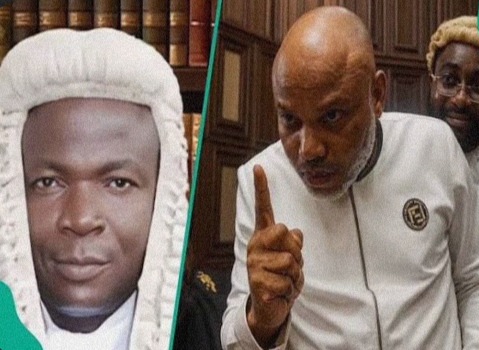
Five months after the Nnamdi Kanu conviction, Nigeria remains deeply divided over one of the most consequential legal and political cases in its recent history. The sentencing of the IPOB leader to life imprisonment by Justice James Omotosho marked a turning point, not just for the Indigenous People of Biafra (IPOB), but for debates surrounding justice, sovereignty, and international law.

As the dust settles, critical questions linger:
Was justice served?
Were international legal standards upheld?
And what does this case mean for Nigeria’s democratic and judicial future?
From Arrest to Conviction: A Controversial Journey
Kanu’s legal troubles date back years, but the defining moment came in June 2021, when he was returned to Nigeria under controversial circumstances from Kenya.
The Nigerian government maintained that his return was lawful, while critics described it as an extraordinary rendition, a claim later echoed by the UN Working Group on Arbitrary Detention, which declared his detention arbitrary and called for his release.
</span style="font-size:>

Despite this, Nigeria pressed forward with prosecution under the Terrorism (Prevention) Act. Following years of legal back-and-forth, including a temporary discharge by the Court of Appeal of Nigeria and reversal by the Supreme Court of Nigeria, the case culminated in a life sentence in late 2025.
The Court’s Position: Incitement as Terrorism
At the heart of the conviction was the court’s interpretation of Kanu’s broadcasts.
The prosecution argued that:
a. His radio messages incited violence
b. His rhetoric contributed to unrest linked to IPOB activities
Under Nigerian law, incitement alone can constitute terrorism, even in the absence of physical weapons. This legal position proved decisive. However, critics argue that: a. The evidence relied heavily on statements rather than actions, questioning his conviction when terrorists and armed are receiving state pardon with compensations. b. The threshold for terrorism may have been stretched These concerns are now central to ongoing appeals.

International Law vs National Sovereignty
Perhaps the most contentious aspect of the case lies in its international implications. The UN Working Group’s opinion placed Nigeria under moral pressure, but not legal compulsion. Meanwhile, Kanu’s status as a dual citizen raised expectations of intervention from the UK Foreign, Commonwealth & Development Office. Yet, the UK’s role has remained limited.
Why?
- International law prioritizes state sovereignty
- Dual nationals are treated primarily as citizens of the country they are in
- Foreign governments cannot override domestic judicial processes This has left critics frustrated and supporters of the conviction resolute.

Public Reaction: A Nation Divided
The Nnamdi Kanu conviction has raised concerns across Nigeria, with reactions sharply polarized.
Supporters argue:
- The conviction reinforces national security
- No individual should incite violence without consequences
Critics insist: - The trial was fundamentally flawed
- The rendition tainted the entire process
- The judgment risks suppressing dissent
In the Southeast, the case continues to evoke strong emotional and political responses, with periodic tensions underscoring its unresolved nature.
Life in Detention: The Sokoto Factor
Reports indicate that Kanu is currently held at the Sokoto Correctional Centre. His legal team has sought:
- Transfer closer to Abuja for easier access to counsel
- Improved conditions for appeal preparation
So far, these efforts have not yielded success.

Appeal and What Lies Ahead Five months on, the legal battle is far from over.
Appeal and What Lies Ahead Five months on, the legal battle is far from over.
Key issues expected to shape the appeal include:
1. Legality of the 2021 rendition
2. Admissibility and weight of evidence
3. Interpretation of incitement under terrorism law
4. Compliance with constitutional and international protections
Legal experts note that appellate courts will ultimately determine whether the conviction stands or is overturned.
Legal Questions Surrounding the Nnamdi Kanu Conviction: A Defining Test for Nigeria’s Justice System
Beyond the individual, this case represents a broader test. It raises fundamental questions:
1. Can procedural irregularities invalidate prosecution?
2. How should courts balance security with civil liberties?
3. What weight should international opinions carry in domestic law?
For Nigeria, the answers will shape not only this case but future legal standards.

Still Unfinished
Five months on, the Nnamdi Kanu conviction remains far from being concluded. It is a case that sits at the intersection of law, politics, and identity, one that continues to challenge institutions and provoke debate. Whether history will view the conviction as a triumph of justice or a miscarriage of it remains uncertain.

For now, one thing is clear: The final chapter has yet to be written.