
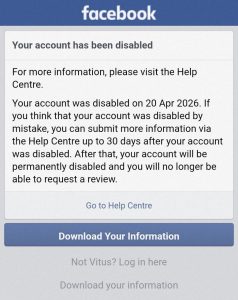
Facebook account disabled is the phrase that now defines one of the most challenging experiences of my digital life. After Meta disabled my Facebook account, I made every reasonable effort to recover it but ultimately lost access. This article explains what happened, the barriers I encountered, and why I continue to seek transparency, accountability, and a fair review of my case.
There are moments when an individual's experience with a technology platform becomes more than a personal setback. It raises broader questions about digital rights, due process, corporate accountability, and the responsibilities of platforms that have become integral to modern communication and public life. For me, the loss of my Facebook account became one of those moments.
What I believe began as a compromise of my account developed into a prolonged effort to regain control of an online identity I had built and relied upon for years. Facebook later informed me that the account had been involved in restricted activity and granted a limited period during which I could recover it.
The difficulty, however, was not a lack of willingness to comply with the recovery process. It was that the recovery mechanism I was expected to use was not accessible when I needed it most. Despite my efforts to follow the prescribed steps and obtain assistance from Meta, I was unable to access a functional recovery pathway. The recovery period expired, and with it, my opportunity to regain the account.
Subsequent attempts to obtain meaningful support produced no substantive resolution. Even my efforts to establish a new Facebook presence have encountered further obstacles, leaving important questions unanswered.
This is therefore not merely the story of a lost social media account. It is about the protection of digital identity, the transparency of platform decision-making, procedural fairness, cybersecurity, the practical implications for journalists and other public communicators, and the rights of ordinary users when significant decisions are made through systems they cannot see or effectively challenge.
I am publishing this account of my Facebook account disabled, not to assign blame or make unsupported allegations, but to invite transparency and encourage constructive dialogue. I believe Meta should have the opportunity to explain the processes that affected my account, and I hope that sharing my experience may also help illuminate similar challenges faced by other users.
This article distinguishes carefully between what can be established through my experience and available documentation, what remains unproven, and what, in my view, deserves impartial examination. It is ultimately a call for greater transparency, procedural fairness, and meaningful user support whenever account enforcement decisions carry significant personal or professional consequences.
The Account at the Centre of This Story
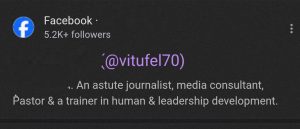
The Facebook account disabled involved in this experience was registered in my name and the username associated with the account was: VITUFEL70 I used the account as a personal communication platform and as part of my wider public engagement. I am a journalist and public affairs analyst. Over time, Facebook became one of the platforms through which I communicated, interacted with people, participated in public conversations and maintained relationships. Like millions of people around the world, I regarded the account not merely as a password-protected webpage but as part of my digital identity. It contained years of communication, relationships, photographs, contacts and personal history. Then something went wrong.
Was My Account Hacked?
My understanding is that the account was compromised. I subsequently encountered restrictions associated with activities that I did not believe represented my normal use of Facebook. Facebook informed me that restricted activities had taken place on the account. This is where an important distinction must be made. I am not claiming that I can independently prove every action that occurred on the account while I was unable to control it. Rather, my position is that if an account is compromised and another person uses it to violate platform rules, the legitimate account owner should have a meaningful opportunity to establish that fact and recover the account. That opportunity, in my experience, did not work as it should have.
The 30-Day Recovery Window
Facebook gave me a period of approximately 30 days within which I was expected to recover or appeal the decision. On paper, that sounds reasonable. A platform needs rules. Users who violate those rules may legitimately face restrictions. And Meta, like every major technology company, has a responsibility to protect its users from abuse, fraud, harassment, threats and other harmful activities. I do not dispute that principle. My concern is about what happens when the enforcement decision itself may have been triggered by a compromised account, and the account owner cannot effectively access the mechanism provided to challenge the decision. That is where due process becomes important. During the recovery period, I was unable, according to my experience, to access the necessary recovery controls in a meaningful way. The clock continued to run. The 30-day period eventually expired. And the account remained inaccessible.
The Most Frustrating Part: The Door to Appeal Was There, But I Could Not Walk Through It
This is perhaps the most important part of my experience. Imagine being told: "You have 30 days to recover your account."
Then imagine trying to recover the account but finding that the mechanism you are supposed to use does not allow you to complete the process. The deadline does not stop. The system does not appear to understand the problem. There is no human being you can easily speak with. You submit communications. You wait. And eventually the recovery period expires. What happens then?
For the affected user, the distinction between “you were given an appeal” and “you had an effective opportunity to appeal” becomes enormous. Those are not necessarily the same thing.
I Wrote to Facebook
I did not simply abandon the account. I made attempts to communicate with Facebook. I wrote letters and sought assistance. I explained the circumstances surrounding the account. I sought clarification. I wanted to know: What exactly had happened? What activity caused the restriction? When did it happen? Was the activity carried out by me or by someone who had gained unauthorized access to my account? What evidence did Meta have? What could I do to prove ownership and recover the account? But I did not receive the substantive response I was hoping for. That silence became part of the problem. When a platform has the power to remove a person's digital identity from its ecosystem, the user should not be left wondering whether anyone has actually examined the case.
What Does Meta Say Happened?
This is where I want to be particularly fair to Meta on my Facebook account disabled. I am not claiming to know everything that happened inside Meta's systems. I do not have access to Meta's internal logs. I do not know which automated systems or human reviewers examined my account. I do not know whether the account was flagged automatically or manually. I do not know whether a third party reported it. I do not know whether the activities attributed to the account occurred before or after it was compromised. And I do not know whether any government agency, political actor or other third party ever communicated with Meta about my account. These are precisely the questions that Meta should answer.
A Broader Problem: Meta's Own Oversight Board Has Raised Concerns
My experience would be easier to dismiss as an isolated complaint if there were no broader concerns about Meta's account-enforcement system. But there are.
In June 2026, the Oversight Board, Meta's independent oversight body, published a decision concerning Meta's approach to permanently disabling accounts. The Board said it had due-process concerns about how Meta disables user accounts and about account governance more broadly. It called for greater transparency concerning account enforcement and emphasized the need for fair and effective appeals.
The Board specifically said users should receive clear information about the reasons for account disablement and have access to reliable appeal mechanisms. It also said platforms should provide information about the role of government requests in the review or disabling of an account and about the role of automation in reviews.
That point is particularly important. Because when an account belonging to a journalist or public commentator disappears without a satisfactory explanation, legitimate questions naturally arise. Was it an automated decision? Was it a human decision? Was the account compromised? Was it mass-reported? Was there a government request? Was there a coordinated campaign? Or was it simply a mistake? The user should not have to guess.
The Oversight Board Has Heard Similar Complaints
This is not merely theoretical. In its June 2026 discussion of account disabling, the Oversight Board reported that it had received an enormous volume of complaints from users who had lost access to their accounts.
The Board said many users reported that they:
- did not understand why their accounts had been disabled;
- believed the reason given was wrong;
- could not appeal;
- could not obtain meaningful explanations;
- could not download their information;
- believed decisions had been made automatically;
- or said their accounts had been compromised before enforcement occurred.
The Question of Automation
Another question deserves attention: Was my account reviewed by a human being? Modern technology companies use automated systems to identify suspicious activities and potential policy violations. That is understandable. Facebook has billions of users. It would be practically impossible for humans to manually examine every piece of content and every account activity. But automation creates another problem.
An automated system may see: Account X performed prohibited activity.
The human reality may be: The legitimate owner of Account X had lost control of the account.
Those are two very different realities. If the system does not adequately distinguish between them, an innocent account owner can become the person punished for the actions of an intruder. That is why meaningful human review matters in disputed cases.
The Oversight Board has specifically called for effective and fair appeals and for human review in appropriate edge cases.
Then Something Else Happened
After losing access to the original account, I attempted to establish another Facebook presence. This did not solve the problem. I encountered restrictions when attempting to establish a new account.
More recently, I attempted to create a Facebook Page using my name as usual. I got restricted. I tried using my second name but it was traced back to me, and I was blocked.
The proposed Page Name was straightforward, yet I was not allowed.
Page name: My Middle Name as Lead Name
Category: Public Figure
Bio: Journalist, Christian minister, humanitarian and community development advocate inspiring faith, service, empowerment and positive transformation.
There is nothing inherently controversial about those words. Yet Facebook returned: “An error occurred while creating the page. Please ensure that you are following Page policies.”
Again, I cannot claim to know the technical reason for this error. It may be an account-level restriction. It may be an automated integrity check. It may be related to the previous disabled account. It may be a temporary technical problem. Or it may be something completely different. But given the history, the error deserves an explanation.
Why I Am Raising This Publicly
Some may ask: "Why not simply create another account and move on?" I might not simply do that because digital identity does not work that way anymore.
For journalists, public affairs analysts, civil society actors, community leaders, entrepreneurs, activists and organizations, social media accounts can represent years of accumulated relationships and public communication.
A Facebook account may contain:
- professional contacts;
- sources;
- community networks;
- photographs;
- publications;
- correspondence;
- historical records;
- audience relationships;
- and evidence of previous public engagement.
Was There Political Interference?
Now I come to the most sensitive part of this story. I have concerns about whether political interests may have played a role in what happened to my account. As a journalist and public affairs analyst, I have participated in public discourse and discussed matters of public interest. Nigeria's political environment is intensely contested. People disagree. Powerful people sometimes dislike criticism. And social-media platforms have become important arenas for political communication. I therefore cannot simply dismiss the possibility that someone may have wanted my online presence restricted.
However, I do not currently possess evidence proving that a Nigerian politician bribed Meta or instructed Meta to disable my account. That distinction is extremely important.
I am therefore not publishing this article as a declaration that: “Politician X bribed Meta.” I have no evidence that would justify naming a person in that manner. Instead, I am asking:
Did anyone request action against my account?
Did Meta receive any government or political complaint concerning my account?
Was my account subjected to coordinated reporting?
Was there an internal escalation?
Was the account flagged because of its content, its associations, or because of activities conducted after it was compromised?
Was any Nigerian government agency involved?
Was any political actor involved? These questions deserve answers.
My Friend's Experience Raised Another Question
There is another incident that made me more concerned. A friend of mine publicly discussed my Facebook situation on her own Facebook page.
Following that, she was temporarily restricted by Facebook "for speaking for one particular figure". Again, I must be careful. I cannot prove that Facebook restricted her because she mentioned my name. but "for speaking for one particular figure" is what caught my attention.
Anyway, there could have been something else in her post that triggered the restriction. There could have been an automated error. There could have been a completely unrelated violation.
Without Facebook's internal records, I cannot know. But the timing raised questions and that phrase too. And that is precisely why transparency is so important. If Meta believes the restriction was unrelated to my case, it should be possible to explain that.

I Am Not Asking Meta to Abandon Its Rules
Let me be absolutely clear. I am not arguing that journalists, politicians, pastors, activists or public figures should be exempt from Facebook's rules. They should not. Nobody should be above reasonable community standards.
If I personally violated a legitimate Meta policy, I expect Meta to tell me what I did, identify the relevant rule and provide an opportunity to challenge the decision where its procedures allow.
If someone used my account to violate Meta's rules, I expect Meta to investigate the possibility of compromise.
If my account was legitimately disabled following a proper review, I expect Meta to explain that decision.
And if Meta made a mistake, I expect the company to correct it. That is accountability, not preferential treatment.
What I Am Asking Meta to Explain
I am therefore publicly asking Meta for answers to the following questions.
- What specific activity caused my account to be restricted?
- I would like the date, nature and relevant policy category.
- Was the activity actually performed by me?
- If Meta believes it was, what evidence supports that conclusion?
- Was the account compromised before the alleged violations?
- Why was the recovery mechanism inaccessible during my appeal period?
- Was my appeal ever reviewed by a human being?
- Was my account automatically disabled?
- Was any government request associated with the restriction?
- Was there any coordinated reporting of my account?
- Why have subsequent attempts to establish a Facebook presence encountered restrictions?
- Why was I unable to obtain a substantive response to my correspondence?
I am asking Meta to look at the complete history of my case rather than only the final enforcement status. A proper investigation should consider:
The original account → suspected compromise → suspicious activity → restriction → recovery attempt → inaccessible appeal mechanism → expiry of recovery period → subsequent correspondence → attempts to create a new account → current Page-creation error.
These events should not be examined in isolation. They form a chain.
What Would Prove My Political-Interference Concern?
This question deserves an honest answer. If I am going to raise the possibility of political interference, I should also explain what evidence would be necessary to establish it.
Evidence could include:
- a documented government request to Meta;
- correspondence between a political actor and Meta;
- a law-enforcement request identifying my account;
- an internal Meta case record;
- evidence of coordinated reporting;
- testimony from someone involved;
- or other verifiable documentation linking a political actor to the enforcement decision.
What Is Already Established?
The following facts are established by my direct experience and supported by the available documentation. They are not matters of speculation or opinion, but verifiable facts that form the foundation of this case.
- The Facebook account existed.
- It was registered under a username, VITUFEL70.
- The account was protected by Meta's Three-Factor Authentication system, meaning any attempt to access it would normally trigger a security notification to me.
- The account later became inaccessible following an enforcement action by Meta.
- Facebook informed me that the account had been disabled due to alleged policy-related activity.
- A recovery period was provided during which I was expected to regain access.
- However, throughout that period, I was unable to access any functional recovery options or obtain the guidance necessary to complete the recovery process. Every available recovery pathway appeared inactive, and my repeated requests for assistance from Meta went unanswered.
- The recovery period eventually expired without any practical opportunity for me to restore access to the account.
- Since then, my continued efforts to seek support and resolve the issue have not produced a meaningful outcome.
- Furthermore, my attempts to establish a new Facebook presence have also encountered significant obstacles.
These are the established facts of my experience.
What remains unresolved are the questions surrounding why the account became inaccessible, why the promised recovery mechanisms were unavailable, why repeated requests for assistance received no effective response, and why subsequent attempts to re-establish my presence on the platform have continued to face barriers.
These unresolved issues are the very reason I continue to seek a fair, transparent, and substantive review of my case.
What Remains Unproven?
In the interest of fairness, accuracy, and intellectual honesty, the following matters remain unproven unless supported by credible evidence:
- That any politician or government official directed Meta or Facebook to disable my account.
- That any individual bribed or improperly influenced Meta in relation to my account.
- That any Meta employee in Nigeria or elsewhere engaged in misconduct or acted improperly against me.
- That the restriction placed on my friend's Facebook account resulted from mentioning or advocating my case.
- That the difficulties I have encountered in creating a new Facebook Page are intentionally connected to the restriction of my former account.
- That my original account was definitively hacked, as opposed to being compromised through another technical or security-related mechanism.
But “Unproven” Does Not Mean “Unworthy of Investigation”
Recognizing that a matter is unproven does not mean it should be dismissed without inquiry. On the contrary, unanswered questions often warrant careful and impartial investigation.
If a citizen says: "I believe my account was compromised."
The appropriate response is not: "You are wrong."
Rather, it should be: "Let us examine the available security records and determine what occurred."
If a user asks: "Was there any government request or legal process relating to my account?"
A transparent response would be: "Here is the information we are able to disclose regarding any such requests, consistent with applicable law and policy."
If someone asks: "Was this decision made by an automated system or through human review?"
The appropriate response is: "Here is how the decision was reached and the process that was followed."
Similarly, when a user is unable to access the recovery mechanisms provided by the platform, it is reasonable to ask why those mechanisms failed and whether alternative support should have been available.
This is what transparency, accountability, and procedural fairness look like. They do not require assumptions of wrongdoing. They require a willingness to examine the facts, explain decisions where appropriate, and provide meaningful avenues for review when legitimate concerns are raised.
Why This Matters Beyond Vitufel70
My case is personal. But the underlying issue is much bigger.
Millions of Nigerians rely on Facebook and other social-media platforms.
Businesses depend on them.
Journalists depend on them.
Churches depend on them.
NGOs depend on them.
Community organizations depend on them.
Students depend on them.
Political candidates depend on them.
Families depend on them.
Public institutions depend on them.
For many people, Facebook is effectively part of their public and professional infrastructure. When an account disappears, the consequences can extend far beyond social media.
The Journalism Question
There is another dimension that should not be ignored. I am a journalist and public affairs analyst. Journalists require platforms through which they can communicate with audiences, sources and communities.
That does not give journalists immunity from platform rules. But it makes procedural fairness particularly important when enforcement affects public communication.
The Oversight Board's current work is relevant here. In January 2026, it announced cases examining Meta's approach to permanently disabling accounts, describing account disablement as an urgent concern and emphasizing cases with implications for public discourse.
In June, the Board went further, calling for clear guidance, detailed reasons for account disablement, reliable appeal mechanisms and effective human review. These are not demands I invented for my own case. They are issues now being examined at the highest independent oversight level within Meta's ecosystem.
Meta Has an Opportunity to Correct the Record
This article is not intended to be a declaration of guilt against Meta. It is an invitation to respond. If Meta can demonstrate that:
- my account was legitimately disabled;
- the enforcement was based on activity attributable to me;
- the recovery mechanism was available;
- my appeal was properly processed;
- no political or governmental interference occurred;
- and my current account restrictions have an unrelated technical explanation,
If I have misunderstood what happened, I am prepared to correct the record. But the reverse must also be possible.
If Meta discovers that my account was compromised and improperly disabled, then the company should be prepared to acknowledge the error and take corrective action.
My Appeal to Meta
To Meta, Facebook and the relevant account-integrity and support teams: Please look at my case again. Not through an automated message. Not through a generic help page. Not through a button that disappears before the appeal can be completed.
Please look at the actual history. Look at the account. Look at the security events. Look at the login history. Look at the policy violations attributed to it. Look at the timing. Look at my recovery attempts. Look at the correspondence. Look at the subsequent restrictions. Look at the current inability to establish a Page. Then tell me what happened.
I Want the Truth - Whatever the Truth Is
If my account was legitimately disabled because of something I did, tell me. If it was hacked, tell me.
If the hacker violated Facebook rules, tell me.
If an automated system made a mistake, tell me.
If a human reviewer made a mistake, tell me.
If there was a coordinated reporting campaign, tell me.
If there was a government request, tell me what can lawfully be disclosed. If there was no political involvement whatsoever, say so.
If the current restrictions are completely unrelated to my previous account, explain why. I am not asking for special treatment. I am asking for an explanation.
A Call for Accountability, Not Revenge
There is a temptation, when one feels wronged by a powerful institution, to immediately accuse everyone involved of corruption. I understand that temptation. But journalism demands more. Evidence must remain evidence. Suspicion must remain suspicion until it is proven. And allegations must be identified as allegations. That is why I have deliberately separated what I know from what I suspect in this article. I am not asking readers to conclude that Meta was bribed. I am asking readers to recognize that there are unanswered questions. And I am asking Meta to answer them.
What Happens Next?
I intend to preserve the available documentation surrounding this matter. That includes:
- Facebook notifications;
- account-restriction/disabled messages;
- recovery attempts;
- correspondence;
- screenshots;
- records of subsequent account-creation attempts;
- and any responses received from Meta.
If new evidence emerges concerning the suspected compromise of the original account, that evidence will also be examined.
If credible evidence emerges of political interference, that evidence should be independently scrutinized before publication.
And if the evidence ultimately shows that my assumptions were wrong, I will say so. That is the responsibility of journalism.
The Bigger Question
The question is no longer simply: “Why did Vitufel70 lose his Facebook account?” The bigger question is: What happens when a technology company has the power to remove a person's digital identity, but the person cannot obtain an effective explanation or meaningful avenue of appeal?
That question affects far more people than me. It affects anyone who has ever received the message: “Your account has been disabled.”
It affects anyone whose account has been hacked.
It affects anyone who has lost access to years of photographs and communication.
It affects small businesses whose customers exist on Facebook.
It affects journalists whose audiences exist on social media.
It affects activists and civil society organizations.
It affects public officials and political commentators.
It affects ordinary citizens.
And it raises a fundamental principle: Technology companies should have rules. But users should also have meaningful rights when those rules are enforced against them.
My Message to Meta
I am still willing to listen.
I am still willing to provide documentation.
I am still willing to verify my identity.
I am still willing to explain what happened from my side.
I am still willing to accept a legitimate decision if it is supported by evidence and properly explained.
But after losing an account, being unable to effectively complete the recovery process, receiving no satisfactory response to my subsequent correspondence, and encountering difficulties establishing a new Facebook presence, I believe I have earned the right to ask: What really happened to my account?
And perhaps even more importantly: Who made the decision, and on what evidence?
Meta has the records. I do not. That is why I am asking Meta to provide the answers.
AUTHOR'S NOTE
This article documents the author's personal experience and concerns regarding a previously disabled Facebook account. Where allegations or suspicions are discussed, they are expressly identified as unproven. SkyDNews does not present allegations of political interference, bribery, coordinated reporting or improper conduct by Meta or any individual as established facts without supporting evidence. Meta is invited to respond to the issues raised, and any substantive response received will be considered for publication.

EDITOR'S NOTE / RIGHT OF REPLY
SkyDNews welcomes a response from Meta Platforms, Inc., Facebook, Meta's Nigerian representatives or any other party mentioned or materially concerned by the issues raised in this report. Any response containing verifiable information relevant to the allegations or questions raised will be considered for publication in full or in appropriate summary, subject to normal editorial standards.