Peter Obi Monitoring | By SkyDNews Editorial Desk
Something interesting happened on social media, and Nigerians probably should not just scroll past it.
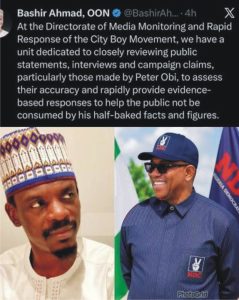
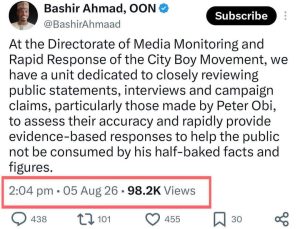
Bashir Ahmad, a former presidential media aide and prominent political commentator, shared a statement announcing that the Directorate of Media Monitoring and Rapid Response of the City Boy Movement has a unit dedicated to closely following public statements, interviews and campaign claims, particularly those made by Peter Obi.
According to the statement, the purpose is to examine those claims, determine whether they are accurate and respond with what the group describes as evidence-based information.
On the surface, there is nothing inherently wrong with that.
Politicians monitor politicians.
Political parties monitor their opponents.
Campaign organisations respond to speeches and interviews. Fact-checking can actually be good for democracy.
But then comes the question that many Nigerians are asking:
Why does a political movement need a dedicated unit specifically paying close attention to Peter Obi?
And perhaps an even bigger question: When does political fact-checking stop being healthy scrutiny and become political warfare? That is where this story becomes interesting.
First, let's be clear about what we know
The screenshot circulating online shows Bashir Ahmad announcing the existence of the media monitoring and rapid response structure within the City Boy Movement.
He specifically says that the unit pays particular attention to statements and campaign claims made by Peter Obi. That is what the statement says.
However, there is an important distinction that should not be lost in the excitement surrounding the post.
There is no verified evidence presented in the statement that the APC, as a political party, formally established an organisation called an “Anti-Peter Obi Directorate.”
There is also no evidence in the statement proving that President Bola Ahmed Tinubu personally ordered such a unit. Those would be separate claims, and they would require separate evidence.
So, for the sake of responsible journalism, let's not turn an interesting political development into something it has not yet been proven to be.
What we do know is that a pro-Tinubu political movement has publicly announced a media-monitoring and rapid-response structure that specifically watches Peter Obi's public statements.
And that alone is worth discussing.
But why Peter Obi?
This is probably the part that has caught people's attention.
Peter Obi is not the only Nigerian politician making statements.
President Bola Tinubu makes statements.
Atiku Abubakar makes statements.
Other presidential hopefuls make statements.
APC leaders make statements.
Opposition politicians make statements every day.
Yet Bashir Ahmad specifically mentioned Peter Obi.
That tells us something.
It tells us that, at least from the perspective of this political movement, Peter Obi's public communication is considered important enough to deserve organised monitoring and rapid responses.
And that creates an amusing contradiction.
For years, Nigerians have heard people dismiss Peter Obi as a politician who “came third.”
Some have even described him as politically irrelevant.
Some say he is a “nobody.” Fair enough.
But if the man is truly a political nobody, why does a political movement need a dedicated team watching what he says?

That question almost answers itself.
So much for the “nobody”
There is something almost humorous about the situation.
Imagine telling Nigerians: “Peter Obi is politically irrelevant. Nobody is paying attention to him.”
Then, in the same breath:
“We have created a unit to closely monitor his statements, interviews and campaign claims and respond rapidly.” Come on.
At least let's be honest with ourselves.
You don't normally create a dedicated monitoring structure around someone you believe nobody is listening to.
Political organisations monitor people who matter.
They monitor people who influence public opinion.
They monitor people whose words can change conversations.
They monitor people who could potentially affect electoral outcomes.
Whether Peter Obi eventually wins anything in 2027 is another question entirely.
But clearly, his political voice has not disappeared.
 Is monitoring an opponent wrong?
No.
Let's be fair.
There is nothing inherently undemocratic about a political organisation monitoring the public statements of its opponents.
In fact, it can be beneficial.
Suppose Peter Obi says: “Inflation is X percent.”
The monitoring team checks the official figures.
If he is wrong, they can say: “No, the official figure is Y percent.”
Then they provide the evidence.
That's democracy.
Suppose Peter Obi says a particular government project cost ₦500 billion.
The monitoring team checks the budget documents and discovers that the actual figure is ₦300 billion.
They publish the documents.
That's democracy too.
Suppose Peter Obi makes a claim about unemployment, education, healthcare, poverty or public debt.
Again, check it.
Bring the evidence.
Let's debate.
There is absolutely nothing wrong with that.
The problem starts when “monitoring” becomes something else.
What exactly does “monitoring” mean?
This is the question the City Boy Movement should probably answer.
Does the unit simply:
- watch television interviews?
monitor social media?
- examine campaign promises?
- compare statements against government records?
But if monitoring means tracking private citizens, harassing political opponents, intimidating critics, collecting personal information or engaging in activities outside lawful political communication, that would be a completely different matter.
There is no evidence in Bashir Ahmad's statement that the unit is doing those things, and SkyDNews is not making such an allegation.
But when any organisation announces a political monitoring operation, it is reasonable for the public to ask what the operation actually involves.
Transparency should not frighten anyone.
The bigger concern: where is the same energy for Nigerians' problems?
And this is where I think Nigerians should have a much bigger conversation.
Political organisations in Nigeria can be incredibly energetic when elections are approaching.
They can mobilise thousands of people.
They can organise rallies.
They can produce videos.
They can monitor opponents.
They can respond to criticism within minutes.
They can flood social media with messages.
They can organise campaign structures across states.
They can even set ambitious targets for the number of votes they intend to deliver.
But where is that same energy when it comes to the problems ordinary Nigerians face?
Where is the rapid-response directorate for out-of-school children?
Where is the rapid-response directorate for unemployment?
Where is the rapid-response team monitoring hunger and food insecurity?
Where is the political movement tracking the condition of primary healthcare centres?
Where is the unit monitoring maternal and child mortality?
Where is the team documenting abandoned government projects?
Where is the structure tracking young Nigerians who cannot find jobs?
Where is the directorate monitoring rural roads?
Where is the team asking why some communities still lack clean water?
Where is the unit monitoring the growing number of Nigerians struggling to survive from one month to another? Those are the things that should keep political organisations awake at night.
Imagine if political parties competed over solutions
Imagine a different Nigeria.
Imagine the APC saying:
“We have a team monitoring education, and we have discovered that 200,000 children in these communities are out of school.”
Then another party responds:
“Our research shows the number is actually 250,000.”
Then both parties debate the numbers.
Then they present their solutions.
Imagine the same thing happening with healthcare.
With unemployment.
With agriculture.
With electricity.
With security.
With poverty.
With climate change.
With housing.
With corruption.
Imagine political parties competing to prove who can solve the greatest number of problems.
Now that would be political competition Nigerians could be proud of.
 Unfortunately, personality politics is easier
The problem is that it is much easier to attack a politician than to solve a national problem.
It is easier to make a video mocking Peter Obi than to build a school.
It is easier to trend a hashtag than to create jobs.
It is easier to insult an opponent than to fix a hospital.
It is easier to produce propaganda than to reform an institution.
It is easier to tell Nigerians that your opponent is bad than to explain exactly how you intend to make their lives better.
And this is why Nigerians must be careful.
The 2027 election must not become one gigantic personality contest.
Peter Obi should also welcome scrutiny
There is another side to this conversation.
If Peter Obi wants to lead Nigeria, he should be prepared to have every major statement examined.
He should welcome fact-checking.
His supporters should welcome fact-checking.
If he makes a mistake, he should be corrected.
If his numbers are wrong, they should be challenged.
If his policies have weaknesses, those weaknesses should be exposed.
That's politics.
The same standard, however, must apply to everyone else.
Tinubu should be monitored too
If a political organisation believes Nigerians deserve accurate information, then that principle cannot stop at Peter Obi.
President Tinubu's statements should be examined too.
APC claims should be examined too.
City Boy Movement claims should be examined too.
Government statistics should be examined too.
Opposition claims should be examined too.
Every politician should be subjected to the same standard.
If someone says Nigeria's economy is improving, show the numbers.
If someone says unemployment has fallen, show the evidence.
If someone says millions of jobs have been created, show the jobs.
If someone says insecurity has improved, show the evidence.
If someone says education is improving, show the enrolment and learning outcomes.
If someone says Nigerians are better off, let the ordinary Nigerian have a say.
Evidence should not have a political party.
The real danger is partisan fact-checking
There is a difference between fact-checking and partisan fact-checking.
Fact-checking says:
“This statement is wrong because the evidence says otherwise.”
Partisan fact-checking can become:
“This statement is wrong because we don't like the person who said it.”
Those are not the same thing.
A proper fact-check should be able to survive without knowing whether the speaker is APC, Labour Party, PDP, ADC or any other political party.
The question should simply be:
Is it true?
Will they fact-check their own side?
Here is a simple challenge to the City Boy Movement.
If you are going to monitor Peter Obi, excellent.
But will you also monitor your own people?
Will you fact-check President Tinubu?
Will you fact-check APC officials?
Will you fact-check City Boy Movement leaders?
Will you correct your own side when they get their facts wrong?
Will you publish corrections when you make mistakes?
Will you show Nigerians the sources behind your findings?
If the answer is yes, then perhaps the initiative could make a useful contribution to Nigerian political discourse. But if the monitoring unit exists simply to find ammunition against Peter Obi while ignoring false or misleading claims from its own political camp, then Nigerians have every right to question its credibility.
 “He came third”
This argument deserves a little attention.
The repeated claim that Peter Obi “came third” in 2023 is technically a reference to the official outcome of the presidential election.
But coming third in one election does not mean a politician ceases to matter.
Politics is not a school examination where coming third means you disappear from public life.
Politicians lose elections and return.
Political movements grow.
Public opinion changes.
Coalitions change.
Circumstances change.
History is full of politicians who were once dismissed and later became major forces.
Nobody can honestly predict the final outcome of 2027 today.
So whether Peter Obi wins, loses, changes political platform, forms a coalition or chooses another political path is something Nigerians will ultimately decide.
Not Bashir Ahmad.
Not Peter Obi. Not Tinubu.
Not City Boy Movement.
The Nigerian voter decides.
And that is the point
This is why the 2027 election must be approached carefully.
We should not allow political desperation to turn Nigeria into a permanent battlefield of insults, propaganda and character assassination.
Political competition is healthy.
Political disagreement is healthy.
Criticism is healthy.
Fact-checking is healthy.
Even fierce debate is healthy.
But Nigerians deserve better than political warfare disguised as public service.
We need monitoring that actually matters
If political organisations have the resources and manpower to monitor every statement made by political opponents, then perhaps they can also monitor something else:
Nigeria itself.
Monitor the schools.
Monitor hospitals.
Monitor roads.
Monitor markets.
Monitor food prices.
Monitor job creation.
Monitor government spending.
Monitor public procurement.
Monitor agricultural production.
Monitor children's education.
Monitor poverty.
Monitor disability inclusion.
Monitor environmental degradation.
Monitor access to clean water.
Monitor the treatment of internally displaced persons.
Monitor corruption allegations.
Monitor public projects.
Monitor human rights.
Monitor the promises politicians make, and whether they keep them.
That would be a monitoring directorate Nigerians could truly celebrate.
We should not be afraid of political scrutiny
There is nothing wrong with politicians watching each other.
In fact, perhaps Nigeria needs more scrutiny, not less.
But scrutiny must work both ways.
If Peter Obi says something questionable, challenge him.
If Tinubu says something questionable, challenge him.
If Atiku says something questionable, challenge him.
If an APC official says something questionable, challenge him.
If a Labour Party official says something questionable, challenge him.
If Bashir Ahmad says something questionable, challenge him.
If SkyDNews gets something wrong, challenge us too.
That's democracy.
The City Boy Movement now has an opportunity
Bashir Ahmad's announcement has unintentionally created an opportunity for the City Boy Movement to tell Nigerians more about what it is doing.
The organisation can explain:
What exactly does the Directorate monitor?
Who works there?
What methodology does it use?
What sources does it rely upon?
Who verifies its findings?
Does it publish corrections?
Will it monitor claims made by Tinubu and APC officials with the same seriousness?
These are reasonable questions.
There is no need to become defensive.
If the work is genuinely evidence-based, then the evidence should speak for itself.
So much for the “nobody”
And perhaps we should end where we began.
For those who insist that Peter Obi is “a nobody” and that he “came third”:
So much for a nobody who apparently deserves a dedicated rapid-response monitoring unit.
But beneath the laughter is a serious point.
The fact that a political movement considers it necessary to closely monitor what Peter Obi says does not mean he will win the 2027 election. It does not mean he is always right.
It does not mean his supporters are right.
It does not mean Tinubu will lose.
It simply means that his voice still matters enough in Nigeria's political conversation to attract organised attention.
And that is something Nigerians should acknowledge honestly.
Nigeria deserves a better political conversation
The coming election should not be about who can shout the loudest.
It should not be about who can produce the most insulting meme.
It should not be about who can destroy an opponent's reputation fastest.
It should not be about who has the biggest social-media army.
It should be about ideas, competence, character, evidence and results.
If Peter Obi has good ideas, let him defend them.
If Tinubu's administration has good results, let the government present them.
If APC believes it deserves another mandate, let it explain why.
If the opposition believes it can do better, let it explain how.
Then let Nigerians listen.
Let Nigerians compare.
Let Nigerians question.
And finally, let Nigerians vote.
Because at the end of all the monitoring, rapid responses, political meetings, social-media battles and campaign slogans, there is one person who still has the final say:
The Nigerian voter.
And that is the person every political organisation should ultimately be monitoring, not for the purpose of manipulating their choice, but for the purpose of understanding what Nigerians actually want.
Nigeria belongs to all of us.
2027 should be a contest of ideas, not a war of desperation.