Nigeria 2027 elections: Apathy Is Not Neutrality: Don't Allow Hatred, Political Manipulation and Discouragement to Decide Nigeria's Future
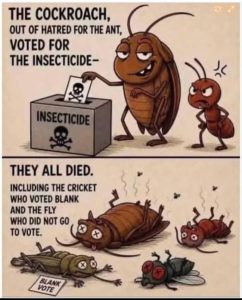
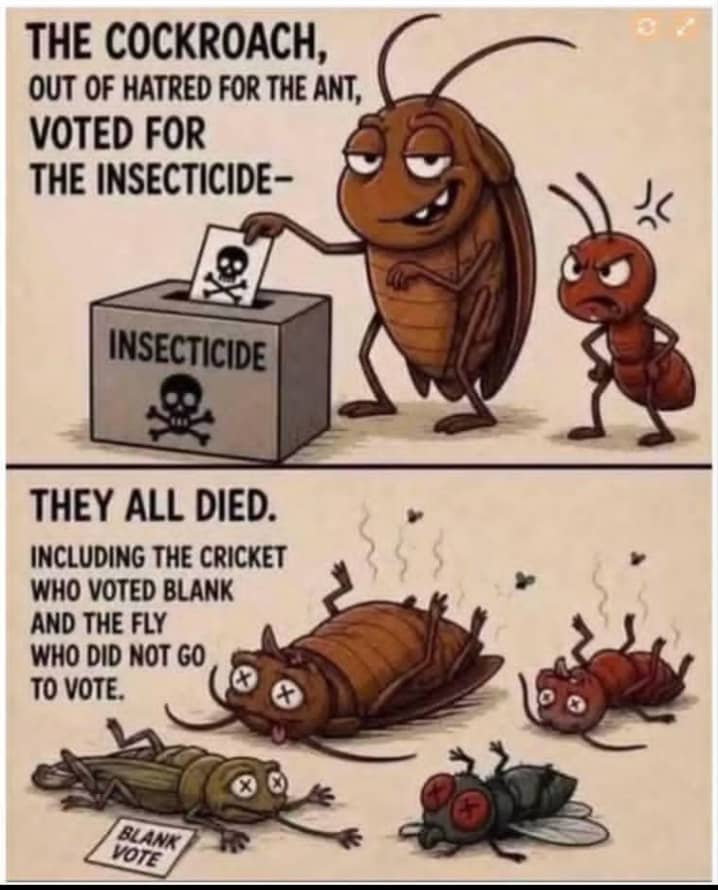
The cockroach that voted out of hatred dies. The cricket that refused to make a meaningful choice dies. The fly that stayed away from the election dies. What should Nigerians learn from this? An election is not simply about defeating the person you dislike. It is about making a decision that protects the collective future of the people. This is particularly important in Nigeria, where political disagreements, ethnic sentiments, religious divisions, party loyalty, personal interests and the desperation of political actors can sometimes make citizens lose sight of the bigger picture. A citizen who votes against another candidate simply because of hatred, without considering the consequences of the alternative, may eventually discover that the consequences of that decision affect everyone. Likewise, a citizen who refuses to vote because of disappointment, frustration or the belief that the outcome has already been predetermined may unknowingly surrender an important democratic responsibility. The lesson is clear: Do not allow hatred to choose your candidate, and do not allow discouragement to take away your vote.
Nigeria 2027 Elections: Why Every Eligible Voter Must Participate
One of the greatest dangers to democracy is not necessarily the number of political parties contesting an election. It is the number of eligible voters who become so discouraged that they decide not to participate. When citizens withdraw from the electoral process, they create an opportunity for a relatively small number of organised voters, political interests and powerful networks to exercise disproportionate influence over the outcome. This is why Nigerians must be careful about messages designed to convince them that voting is useless. You will hear statements such as:
-
"Your vote will never count in Nigeria."
-
"The election has already been concluded."
-
"The winner has already been selected."
-
"INEC will announce whoever the government wants."
-
"Why waste your time standing under the sun to vote?"
-
"Nothing will change, irrespective of who you vote for."
-
"Forget your mobilisation. There is nothing you can do."
Some of these statements may come from genuinely frustrated citizens who have lost confidence in the electoral system. Others may be politically motivated attempts to weaken public participation. Nigerians must learn to distinguish between legitimate criticism of electoral institutions and deliberate efforts to discourage citizens from exercising their democratic rights. Yes, Nigeria has experienced controversial elections, electoral violence, vote buying, manipulation allegations, logistical failures and disputes over results. These problems must not be denied or excused. But what is the solution? Is it to abandon the electoral process and allow those who are determined to control political power to operate without meaningful opposition from the electorate? Certainly not.
If you refuse to participate because you believe your vote will not count, you may be surrendering the very opportunity you have to influence the outcome. Those who want credible elections must demand transparency, accountability, effective electoral administration and protection of the ballot. They must also encourage citizens to register, collect their voter cards, vote and monitor the process lawfully. Democracy cannot be strengthened by citizens surrendering their responsibilities.
Nigeria 2027 Elections and the dangerous politics of declaring an election concluded before voting
Do not vote out of hatred: The cockroach's mistake could become Nigeria's tragedy
-
Does this candidate understand the economic problems facing ordinary Nigerians?
-
What is the candidate's position on insecurity?
-
What practical solutions does the candidate offer for unemployment?
-
What is the candidate's record in public service?
-
Does the candidate demonstrate integrity, competence and accountability?
-
What policies will improve education, healthcare, agriculture and infrastructure?
-
Will the candidate protect the interests and rights of citizens, including those who did not vote for them?
In the coming Nigeria 2027 Elections, do not vote for somebody simply because they belong to your ethnic group. Do not vote for somebody simply because they belong to your religious community. Do not vote for somebody because they have promised to punish your political enemies. Do not vote for somebody merely because you dislike another candidate. Most importantly, do not support a candidate whose policies and conduct threaten the collective wellbeing of the country simply because you believe that candidate can defeat someone you dislike. The cockroach wanted the ant to suffer. Unfortunately, it failed to realise that the insecticide would not distinguish between friends and enemies.
Nigeria is bigger than any political party, candidate, ethnic group or religious organisation. The consequences of poor leadership are not restricted to the supporters of the winning political party. Inflation affects families regardless of their political affiliations. Insecurity threatens communities regardless of their voting preferences. Unemployment affects young people regardless of the candidates their parents supported. A bad political decision can become a national burden.
The cricket and the fly: Silence and withdrawal are not necessarily protection
The cartoon also presents two other important characters. The cricket cast a blank vote, while the fly refused to participate. Both eventually died. Their fate communicates another uncomfortable truth: refusing to make a meaningful electoral choice does not automatically protect anyone from the consequences of political decisions. The cricket participated but failed to make a meaningful choice. The fly stayed away altogether.
In Nigeria, there are citizens who say they will never vote again because previous elections disappointed them. Others say they are politically neutral and therefore have no reason to participate. Some young people believe politics is dirty and that responsible citizens should stay away from it. But politics is not limited to politicians. Government decisions affect the daily lives of everybody, including those who refuse to participate in elections. When you stay away, the government that emerges will still make decisions about your electricity, education, transportation, healthcare, employment, security, taxation and economic opportunities. Your decision not to vote does not exempt you from the consequences of governance.
Equally, deliberately spoiling a ballot or casting an invalid vote is not the same as making a valid choice. If you are dissatisfied with the available candidates, express your concerns, scrutinise their records, engage in peaceful political advocacy and make the most informed lawful choice available to you. You cannot effectively demand accountability from a system you have completely abandoned.
Grassroots mobilisation: Never underestimate the power of one person
There is something political actors sometimes underestimate: the power of ordinary citizens to influence conversations within their communities. A person who convinces five neighbours to obtain their voter cards and participate has made a contribution. A community meeting attended by 20 people may influence an entire neighbourhood. A youth leader who organises a peaceful voter education session may help hundreds of young people understand their electoral responsibilities. A woman who discusses candidates' policies with other women in her market association is contributing to democratic participation. A student who educates family members about the importance of informed voting is making a difference. A religious or traditional leader who encourages peaceful participation without imposing a political choice is also contributing to democracy. Do not underestimate these little efforts.
Do not spread unverified election information. Do not intimidate people who support different candidates. Do not buy votes or encourage electoral violence. The objective should not be to manufacture political hatred. It should be to empower citizens to make informed decisions. One informed voter can influence another. One community conversation can change political attitudes. One determined citizen can help awaken an entire neighbourhood.
Nigeria's 2027 elections: The time to prepare is now
Nigeria is approaching another important electoral milestone. The 2027 general elections provide citizens with an opportunity to participate in determining who occupies important public offices. According to the revised timetable published by the Independent National Electoral Commission (INEC):
2027 Nigerian General Elections
Election Day |
Election Type |
Saturday, 16 January 2027 |
Presidential and National Assembly elections |
Saturday, 6 February 2027 |
Governorship and State Houses of Assembly elections |
Source: INEC's revised 2027 election timetable.
These dates make the present period particularly important for voter education, political accountability and lawful grassroots mobilisation. Nigerians should not wait until the last few days before an election to become interested in the political process. Now is the time to examine candidates, understand their policies, discuss national challenges and ask serious questions about the future. The presidential and National Assembly campaigns commenced on 19 August 2026, while governorship and State Assembly campaigns commenced on 9 September 2026. Campaigns must conclude 24 hours before the respective election days. This means political engagement should be active, but it must remain peaceful and within the law.
Get your PVC ready
Your Permanent Voter Card (PVC) is an important requirement for participating in the election under the current INEC voting arrangements. If you have registered, do not assume that everything is automatically in order.
-
Confirm that your voter registration details are correct.
-
Check whether your PVC is ready for collection.
-
Collect your card from the designated INEC collection centre if you have not done so.
-
If your card is lost or damaged, consult INEC about the replacement procedure.
-
If you have relocated, check the official procedure for transferring your registration.
-
Confirm your designated polling unit before election day.
INEC's official voter portal provides services for checking registration information, finding collection centres and requesting replacement or transfer where applicable.
Official portal: INEC Continuous Voter Registration and Voter Services.
Vote, but also protect the integrity of the process
Voting is only one part of democratic participation. Citizens should also pay attention to what happens at polling units and during the collation and announcement of results. On election day:
-
Arrive at your designated polling unit and follow INEC instructions.
-
Complete accreditation and voting as prescribed.
-
Cast your ballot independently and without intimidation.
-
Refuse vote buying and the sale of your electoral choice.
-
Do not participate in violence or electoral malpractice.
-
-
Report credible incidents through appropriate official channels.
-
Follow verified information from INEC rather than rumours.
Political parties and their agents also have responsibilities in protecting the electoral process. Citizens should insist that votes are properly counted, results are accurately recorded and electoral complaints are addressed through the appropriate legal channels. It is not enough to encourage people to vote. We must also demand an electoral environment in which their votes are respected.

Stop allowing political pessimism to become a national culture
One of the unfortunate developments in our political conversations is the normalisation of hopelessness. Some people have become so accustomed to electoral disappointment that they now discourage others from participating. Whenever somebody announces an intention to mobilise voters, another person quickly responds that the effort is useless. Whenever a group organises a political discussion, somebody declares that the outcome has already been determined. Whenever citizens begin discussing alternatives, they are reminded that powerful individuals will always have their way. This attitude is dangerous. Yes, citizens have every right to criticise INEC, political parties, candidates and the government. They have every right to question electoral arrangements and demand reforms. But criticism should lead to greater vigilance, not collective surrender.
If you believe the electoral system is vulnerable to manipulation, become more interested in transparency. If you believe political parties are failing Nigerians, demand better candidates. If you believe the political class is disconnected from ordinary people, organise peaceful community engagement. If you believe election results can be manipulated, support lawful election observation, evidence-based reporting and accountability mechanisms. Do not turn your disappointment into a reason for abandoning your democratic responsibility. Those who want a better Nigeria must be willing to participate in building one.
The responsibility of the media, civil society and community leaders
The responsibility of encouraging credible elections does not belong to voters alone. The media must educate rather than manipulate. Journalists must investigate electoral claims, verify information and report developments responsibly. Civil society organisations must strengthen voter education, encourage inclusion and monitor the electoral process within the law. Traditional and religious leaders should promote peaceful participation without using their positions to intimidate or compel political choices. Youth organisations should encourage political literacy and help young people understand that democracy requires more than online arguments. Women should be encouraged to participate fully, not merely as campaign supporters or voting numbers, but as candidates, political decision-makers, election observers and community advocates. People living with disabilities and other marginalised groups must also have meaningful access to the electoral process.
The objective should be an election in which citizens can freely express their choices without intimidation, discrimination or manipulation. Nigeria does not need more political hostility. It needs informed citizens, responsible political leadership and institutions that respect the will of the electorate.