Abuja — The Tinubu ADC promotion, approved by President Bola Ahmed Tinubu, has continued to draw attention within sections of the Nigerian Army, as officers and defence analysts examine the speed of the elevation against long-established military standards.
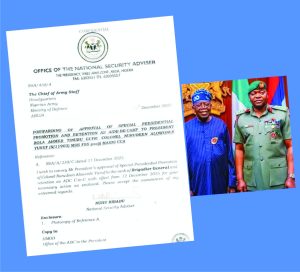
The promotion of Colonel Nurudeen Abiodun Yusuf was conveyed in a letter dated 12 December 2025 and addressed to the Chief of Army Staff, Lieutenant-General Wahid Shaibu, through the office of the National Security Adviser, Mallam Nuhu Ribadu, acting on the authority of the President as Commander-in-Chief of the Armed Forces. As a result of this approval, Colonel Yusuf, who was only decorated as a Colonel in January 2025, received a second promotion within a twelve-month period.
President Bola Ahmed Tinubu pictured with his Aide-de-Camp alongside the official promotion letter.
However, within military circles, the development has raised questions because promotion from Colonel to Brigadier-General is traditionally guided by strict professional benchmarks. Under the Armed Forces of Nigeria Terms and Conditions of Service, officers are generally expected to spend several years at the rank of Colonel, attend advanced strategic training such as the National Defence College (NDC) or an approved equivalent, and pass through formal promotion boards based on seniority, merit, and available vacancies.
Speaking with SkyDNews on condition of anonymity, several serving and retired officers noted that the Tinubu ADC promotion did not follow due process as Colonel Yusuf, has not attended the National Defence College, a factor that has fueled concerns among some of his peers. They also pointed out that his promotion now places him ahead of officers from earlier Regular Courses who have reportedly met all professional requirements and are awaiting elevation through the conventional process.
From a historical perspective, military analysts say rapid promotion of a serving President’s ADC to the rank of Brigadier-General within such a short timeframe is rare. Records from past administrations show that previous ADCs were largely required to follow established procedures. During the administration of former President Muhammadu Buhari, for example, his first ADC, then Colonel Mohammed Lawal Abubakar, was disengaged from ADC duties to attend the National Defence College and remained at the rank of Colonel for the stipulated period before his promotion.
In addition, the decision to retain Brigadier-General Yusuf as ADC has also attracted quiet attention. Traditionally, ADC duties are performed by senior field-grade officers, while general officers are expected to take on command or strategic responsibilities. While the arrangement is not expressly prohibited, military observers describe it as unusual within the structure and culture of the Armed Forces.
Meanwhile, reactions within the Army have been largely restrained, in keeping with military discipline. However, speaking with SkyDNews, some officers expressed concern that perceptions of uneven application of promotion rules could affect morale over time. They warned that the military relies heavily on predictability, fairness, and trust to maintain cohesion and professionalism.
Supporters of the Tinubu ADC promotion, however, argue that the President has wide constitutional powers over military appointments and promotions, especially for officers serving in sensitive national security roles. They note that proximity to the Commander-in-Chief often comes with increased responsibility and exposure, which may influence executive decisions.
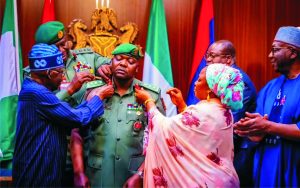
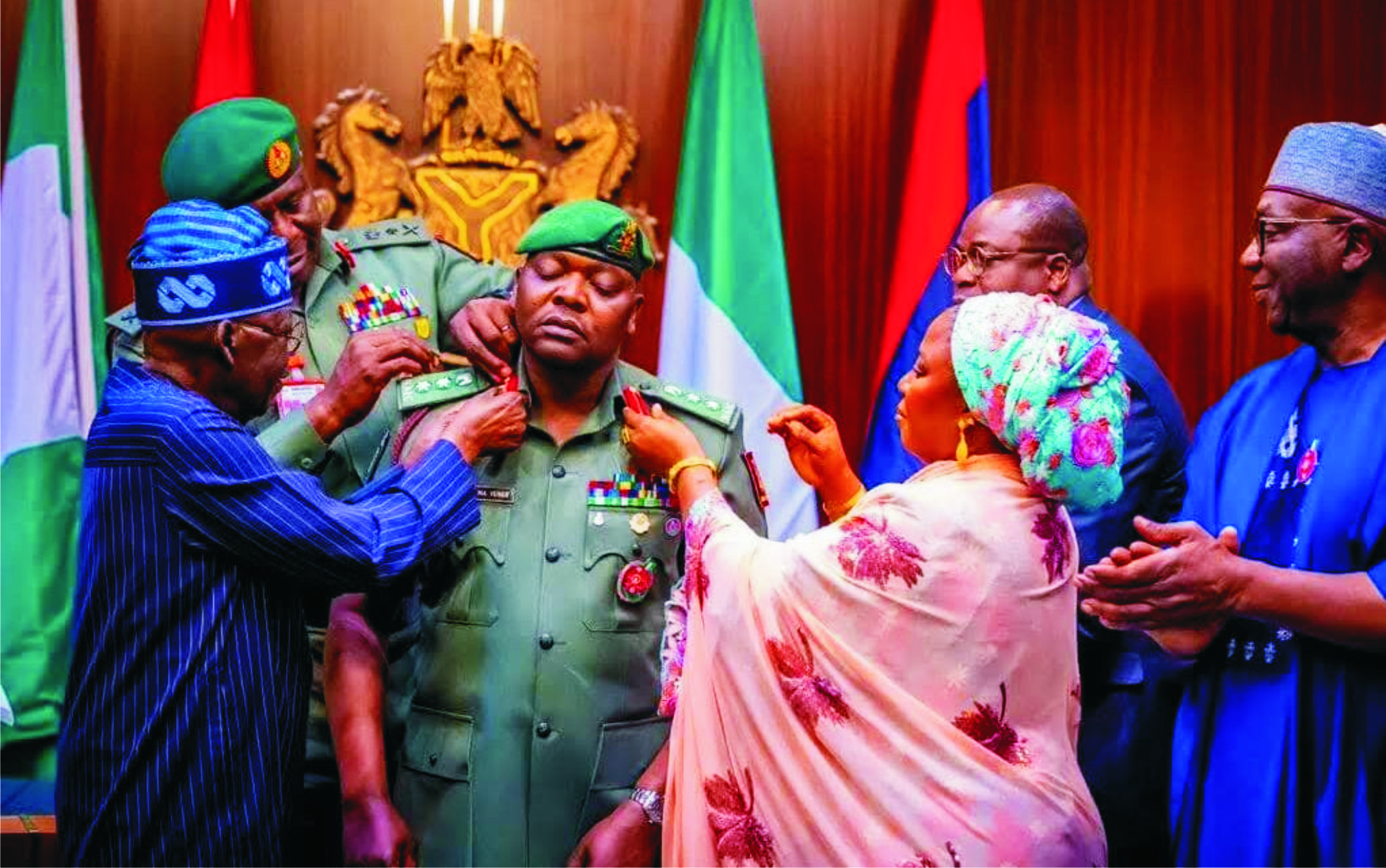
President Bola Ahmed Tinubu during the decoration of his Aide-de-Camp with a new military rank.
In a release responding to public discussions, defence policy experts stressed that while executive discretion is lawful, how it is exercised matters for institutional confidence. They noted that exceptions, if not clearly explained, can shape perceptions and set precedents within highly structured institutions like the military.
As Nigeria continues to confront complex security challenges, analysts agree that public confidence in the Armed Forces depends not only on operational strength but also on adherence to clear and consistent professional standards. For now, neither the Presidency nor Army Headquarters has issued an official public statement addressing the concerns raised.
Nevertheless, the promotion has opened a wider conversation about leadership example, institutional tradition, and the delicate balance between authority and professionalism within Nigeria’s security architecture.
#TinubuADCpromotion